Unveiling the Hidden Network
The Firm
My journey with Hillsong, a branch of evangelical faith in Australia, has inadvertently revealed a hidden network within government agencies and financial institutions. This network is intertwined with organised crime, masquerading as religious devotion while employing deceitful tactics to harass and intimidate targeted individuals.
Social media serves as a double-edged sword; it can harm as much as it helps. Without it, I wouldn’t have been able to piece together the troubling connections in my experience. While criminals exploit these platforms, I have also uncovered a variety of their activities.
I have encountered honey trap operations on three separate occasions. Driven by a sincere desire to assist those affected, as I have witnessed their destructive impact on families, including my own. I identified a recurring pattern of abuse that traces back to my time at the University of Southern California in the United States. My interactions with Chinese communist princelings and their criminal affiliates, the Chinese triad, have granted me valuable insights that allow me to effectively map their intricate networks. The Canary Mission, founded in 2015, highlights a longstanding history of targeting dissenters, indicating a systemic issue that has persisted as far back as the early 1980s.
The Rothschild Dynasty
A Network Built on Human Lives
Rise from humble beginnings in the 18th century shaped the financial world. From the depths of the transatlantic slave trade to revolutions, the Rothschild family stands accused of playing a role in nearly every major global conflict and political upheaval. This investigation will peel back the curtain to uncover the true extent of the Rothschild legacy and their involvement in shaping world events.
Mayer Amschel Rothschild, born in 1744 in the Jewish ghetto of Frankfurt, Germany, trained as a banker and coin dealer. Around the 1760s, he established a small business in Frankfurt, dealing in rare coins and currency exchange, developing a reputation as an expert and bringing him into contact with wealthy noblemen collectors, including Crown Prince William of Hesse-Kassel. He built a relationship of trust with William and became the court banker to Prince William, who was one of the wealthiest nobles in Europe. When Napoleon invaded and William was forced into exile in 1806, he entrusted Mayer with safeguarding his fortune. Mayer invested it, growing the funds and using them to expand the Rothschild operation across Europe through his sons.
Mayer Amschel Rothschild raised his sons to be interconnected but geographically dispersed bankers, forming a tight-knit international financial network. His sons opened branch in a European capital, giving the Rothschilds unmatched transactional reach. They communicated using private couriers and encoded letters, allowing near-instant updates across countries decades ahead of other financial networks. This method was a byproduct of their ingrained practice of espionage, constantly monitoring others to secure an advantage in their dealings.
They dealt with entire nations, financing armies, governments, and infrastructure. Their ability to move funds across borders faster than anyone else through five sons’ network allowed them to outmanoeuvre rivals and control capital flows, especially during wars. There is no evidence that the Rothschilds owned slaverships, plantations, or directly traded slaves. However, there’s credible evidence of indirect financial involvement through banking services to slaver-related industries.
In 1833, the UK passed the Slavery Abolition Act, freeing enslaved people across the British Empire. But instead of compensating the enslaved, the British government paid 20 million pounds to slave owners, taking out a massive loan from Rothschilds and the Barings Bank. Nathan Mayer Rothschild along with his brother-in-law Moses Montefiore, underwrote and profited from the loan that paid the British slave owners mostly Jewish landlords for their loss of property, the slaves. The Rothschilds profited from the systems of dismantling salvery by financing the government that paid reparations not to the enslaved, but to the enslavers.
The Rothschild banks in London, Paris, and Vienna were deeply embedded in the sugar, cotton, and tobacco trade. Colonial plantations and commodity finance for goods produced by enslaved labour, West India merchants, plantation owners, and related companies banked with Rothschild banking system, who provided credit and insurance services. Britain and France’s wealth from the 1700s and early 1800s was inseparable from slavery. Any bank handling government funds, shipping insurance, or colonial investments was almost inevitably entangled. They moved money that fuelled empires built on human lives, and when slavery ended, they cashed in again. It was a clever plan: to end the slave trade, put Britain in debt, thereby solidifying control, all while enhancing its reputation by aiding in the liberation of slaves.
Instead of just focusing on a few countries, why not involve the whole world through debt and taxes by controlling the governments. Just like how Rothschild’s five sons managed their individually controlled territories. This was the ultimate form of enslavement, a strategy that connected economies across the globe, built on a century of careful planning through a worldwide settlement scheme, centuries in the making.
The embedded agents, who have benefited from substantial financial backing from their mothership which operates in many countries, highlight the need for a reevaluation of the Atlas Network’s function. It may be time to consider amending NGO laws to limit “TAX-FREE” donations to under $1 million or similar, with benefits shared by all the tax-paying citizens.
These spy networks can be traced back to the early settlements created by the Rothschild network. This history shows how careful planning and resource management have helped these agents succeed in different political environments. This expansion was complemented by marriages and aggressive financial tactics, reminiscent of the strategies employed by institutional investors like BlackRock. Historical events, such as the Potato Famine in Ireland, were pivotal in establishing the groundwork for the lobbying organisations that function globally today. This mirrors the actions of Mayer Amschel, who dispatched his five sons across Europe to entrap debt and infiltrate royal courts, while his five daughters were strategically married into influential families, marking the inception of the honey pot strategy to gain influence and take over from within. This approach is reminiscent of the recent events surrounding TPUSA, where similar tactics of infiltration were observed.
In today’s world, espionage has evolved beyond traditional boundaries, blurring the lines between external and internal threats. No longer confined to government agencies or foreign adversaries, espionage now infiltrates the lives of average citizens, occurring in their homes, social circles, and even their private spaces like bedrooms and businesses. This shift requires a reevaluation of how we perceive and respond to surveillance and intelligence gathering, as the implications of such intrusions can deeply affect personal privacy and security. The modern landscape of espionage demands that we recognise the pervasive nature of these activities and adapt our understanding of safety in an increasingly interconnected and monitored society.
Before World War I began, the Rothschild banking dynasty was already well-established in Europe. Each branch operated independently but shared information and worked together. They were deeply involved in government finance, infrastructure, and war bonds. During the war, they managed war debts and coordinated international loans, especially from the US to the UK. The Rothschilds organised British war bonds, which were essential for funding the military effort and were pioneers of the foreign currency exchanges. The Paris branch helped secure capital for the war, stabilise the Franc, and manage state loans.
They structured loan packages and sometimes underwrote securities to ensure that allied governments had enough funds to continue fighting. Their influence extended to neutral countries like Switzerland and the US, facilitating fund transfers while avoiding diplomatic issues, funded both sides of the war for profit. Throughout the conflict, they remained bankers to the kings and governments, financing the allied war effort with bonds, loans, and influence. These puppet masters wield significant power in determining the outcomes of wars, often through the control of financial resources.
A notable example is the case of the Kuomintang (KMT) under President Chiang Kai-shek, whose request for war financing was denied. This decision reflected a predetermined outcome, where the side likely to yield greater benefit had already been established, influencing the war’s direction significantly. The tragic reality is that countless heroes have laid down their lives in a conflict fuelled by profit motives, sacrificing their futures and families in a war that served the interests of a select few rather than the greater good of their nations.
Amidst all this, an important document passed between Britain and the Rothschilds, which would change the Middle East forever.
Kalergi Plan
Reflection on Historical Influences Modern Discord
The discord we witness today is rooted in centuries-old divisions that keep us at odds over religion, race, culture, and gender, exemplified by movements like feminism and theories such as the Kalergi Plan. In his memoirs, Richard von Coudenhove-Kalergi, the founder of the Pan-European movement, recounted his meeting with banker Max Warburg in 1924, arranged by Baron Louis de Rothschild. Warburg’s substantial donation of 60,000 gold marks was pivotal in sustaining the movement for three years and forging connections with influential Americans like Paul Warburg and Bernard Baruch. Coudenhove-Kalergi’s first wife, Ida Roland, a Jewish stage star from Vienna, played a crucial role in advancing the Pan-European movement, using her connections to bolster her husband’s political endeavors. In “Praktischer Idealismus,” published in 1925, he depicted Jewish people as an urban intellectual elite and proposed a mixed-race society governed by a spiritual aristocracy, advocating for European integration and a cosmopolitan identity. While his vision resonates with the EU’s open border policies, critics argue that his multicultural perspective has been misconstrued, leading to the contentious Kalergi Plan theory, which often labels dissenters as “racist” or “extremist.” This raises the question: was his vision one of peaceful integration or a clever blueprint for discord?
The call to action begins today: Love thy neighbours, embracing everyone regardless of their religion, race, culture, or gender orientation.
The Balfour Declaration
The Balfour Declaration was a letter from British Foreign Secretary Arthur James Balfour to Lord Walter Rothschild, dated November 2, 1917. It expressed the British government’s support for creating a national home for the Jewish people in Palestine. Lord Rothschild was a key figure in the Rothschild banking family, a prominent supporter of Zionism in the UK, and acted as a link between the British government and the World Zionist Organisation. During World War I, Britain sought support from Jewish communities in the United States and Russia, as well as from Jewish financiers in Europe and America. The Declaration aimed to gain favour with Zionist Jews who could influence public opinion or provide financial backing.
The Rothschilds had been involved in supporting Zionist settlements in Palestine since the 1880s. Anticipating the fall of the Ottoman Empire, Britain wanted to establish its influence in the region. The Balfour Declaration set the stage for the British Mandate in Palestine from 1920 to 1948, which saw an increase in Jewish immigration and became a key document for the Zionist movement, ultimately leading to the establishment of Israel in 1948. It also sparked strong opposition from Arab leaders, contributing to the Arab-Israeli conflict. In November 1917, the Bolsheviks, led by Vladimir Lenin, overthrew Russia’s provisional government, forming the Russian Soviet Federative Socialist Republic, which later became the USSR. Before 1917, the Rothschild branches in Paris and London had financial ties with the Russian Empire, holding significant government debt and being linked to the Franco-Russian alliance.
Tsar Nicholas II found himself deeply indebted to a network of ruthless criminals, a situation exacerbated by his kind-hearted nature and lack of experience in such dealings. Tragically, his entire family was murdered in a ritualistic fashion. As I sifted through his images, I was filled with a profound sorrow of his inability to shield his beloved family from harm, an act I suspect was partly motivated by the desire to prevent the continuation of inherited hemophilia B, a severe bleeding disorder passed down to Tsarina from her grandmother Queen Victoria of the United Kingdom. By this time, most European royals and aristocracy were already entwined with this network’s bloodline.
Many Bolshevik leaders were identified as Zionist Jews, including those involved in the execution of the Romanov family.
Power Dynamic in China
The Role of Zionist Jews
The rise of communism has often been linked to Zionist Jews. In China, there was collaboration between Zionists and communists since World War I, with key figures like Sidney Rittenberg, Israel Epstein, Mikhail Borodin, Hans Shippe, and Solomon Adler involved in the Chinese communist movement. Similar influences were seen in Korea, where individuals like Jakob Rosenfeld and Morris “two-gun” Cohen helped promote communism. This influence extended beyond Asia, impacting events like the Angolan Civil War, where Arcadi Gaydamak was involved, and the Salvadoran Civil War with Ernesto Liebes. These examples indicate that Zionist Jews played a significant role in the development and spread of communism.
China’s connection with Zionism and Jewish identity is intricate, the collaboration between Zionist Jews and the Chinese Communist Party (CCP) has been notable, with some Jews taking on important roles within the party. This partnership is believed to have influenced significant events like the Cultural Revolution and the Great Leap Forward, and the one child law reflecting Zionist strategies.
Jewish communities, such as the Kaifeng Jews, have coexisted peacefully in China since the 8th century, integrating with minimal issues. Early 20th-century leaders like Sun Yat-sen even supported the Zionist movement, and during WWII, Shanghai became a haven for around 20,000 European Jews fleeing the Holocaust (引狼入室), creating a bond over shared experiences of suffering under imperialism. In modern times, China and Israel established diplomatic relations in 1992, focusing on trade, agricultural technology, and defence. Jews in China are often seen through literature and business stories that depict them as shrewd and mercenary, and as individuals willing to prioritise profit over familial bonds and kinship.
Fu Dongju Plan
The “Fu Dongju plan” serves as a poignant political metaphor in Taiwan, symbolising a strategy rooted in internal betrayal. This concept unveils the dynamics of inner circle subversion, drawing parallels with the Rothschild Model. It entails a political party strategically enlisting the offspring of its adversaries, thereby undermining rival factions from within by leveraging familial ties, effectively eroding opposition strength through calculated infiltration.
Fu Dongju 傅冬菊 born on December 30, 1924, in Taiyuan, Shanxi Province, daughter of KMT Commander Fu Zuoyi 傅作義 was integral to this concept. She studied at Chongqing Nankai Secondary School and joined a group linked to the Chinese Communist Party (CCP) in 1941, which included children of high-ranking Kuomintang (KMT) officials. Fu provided the CCP with confidential information about the KMT and its leader, Chiang Kai-shek. After high school, she attended the National Southwestern Associated University, majoring in English, and became active in the student movement, eventually joining the CCP Underground Organisation.
In 1949, Fu Dongju, played a crucial role in persuading her father to surrender Beijing to the CCP. Acting as a communist agent, she monitored and reported her father’s military strategies and influenced him to negotiate rather than engage in conflict, facilitating the peaceful entry of the People’s Liberation Army into Beijing and sealing China’s future.
The “Fu Dongju plan” was referenced in early 2025 by former Taipei Mayor Ko Wen-je 柯文哲, who suggested targeting the children of powerful political and economic figures to gain support, reflecting the intelligence-gathering tactics of the original plan. This dynamic also appears within the KMT, particularly among the eldest daughters of its officials, who often create conflict within families. This pattern has been observed in my family for three generations, where siblings act as handlers, contributing to communist surveillance and undermining future KMT generations.
My three encounters with their honey pot operations revealed a pattern of tactics. Initially, they would obliterate their target’s chances of success, a classic Rothschild example of “marriage market distortion” to make the target less competitive. This strategy had dual purposes: for the female honey pot, it disqualified the target from competition while spreading rumours to damage their reputation; for the male honey pot, it imposed financial constraints, making the target easier to control. If these methods proved ineffective, they would infiltrate the target’s inner circle, employing insiders to manipulate from within, with the same patterns repeating every single time in my situation. It’s clear that anyone who has experienced this network will understand this dynamic due to its repetitive pattern.
The honey pot strategy unveils a nearly century-long operations characterised by the subversion of entire inner circles, including close relatives. Once they succeed, escaping their control becomes nearly impossible unless the target severs all ties, including with their own children. This criminal network also targets children’s inner circles as a strategic preventative measure. The dynamics of pyramid networking serve as a potent subversion tool across all seven mountain spheres, aiming at anyone with potential, which explains the success of their operations. The rise of modern technologies, particularly platforms like Facebook and LinkedIn, has streamlined the identification of target networks, with AI surveillance acting as a means of control and manipulation, replacing traditional human oversight. In history, prior to any wars, the upper echelons of society often faced internal destruction. The true victors of these conflicts are not the original inhabitants but rather those criminals who subverted the system. A poignant example of this is TPUSA, where a young man with a promising future being sacrificed to guide us toward the truth. TPUSA serves as just one of many examples. Its aim to use Kirk’s death as a warning rather than simply erasing him, ultimately exposing their actions. This contrasts sharply with that of Apple Inc., where the creator was eliminated through a bioweapon.
The Ultimate Pyramid Network
Modus Operandi 101, the Rothschild Model
Model “R”
Strategic Friendships: Cultivating ties with influential figures, including royals and the wealthy, utilising blackmail, debt traps and honey traps to secure control and resources for their own agendas.
Controlled Opposition: Groups that seem to challenge the status quo but are controlled by the same powers, creating an illusion of choice while preserving/controlling the existing power structure.
Honey Pot Strategy: Leveraging strategic marriages or relationships to enhance influence and “establish” robust financial networks or to dominate existing ones
Divide & Conquer: Undermining adversaries by instigating internal conflicts, rendering them weaker and more susceptible to manipulation.
Insider Trading: Profiting from turmoil by provoking conflicts and employing covert operatives to maximise financial gains through insider trading practices.
Money Laundering: Concealing the origins of identities by altering names to assimilate into local communities, aiding movement and hiding their motives and wealth. Same principles apply to finance, relationships, and their organisations. This is the reason behind numerous charities and shell companies, and how they buried the true Epstein crime among millions of files. to conceal the crimes.
Global Settlements: Establishing sleeper cells and orchestrating global Jewish settlements as part of a broader strategy for influence and control, similar to how the Rothschilds established control in different regions through their sons.
credit: @RealCandaceO
A Story of Resistance Against Colonial Division
The history of Palestinian unity reveals their joint resistance against colonial rule, often ignored by the British Empire. Muslims and Christians in Palestine lived together peacefully, especially during the Great Revolt of 1936, when various groups joined forces against British control (under the influences of the Rothschilds) and the arrival of Zionist settlers. The common belief that internal divisions led to the revolt’s failure is misleading; it was actually a coordinated effort, with the Arab Higher Committee organising different mobilisations. The British (controlled by Rothschild network) used tactics to sow distrust, spreading propaganda and enforcing martial law, punishing all Palestinians after a British official was killed, similar to how October 7 enabled Israel to take GAZA by force—it’s a familiar tactic, with so much efforts to divide. Yet testimonies show a shared Palestinian history, highlighting the importance of confronting false narratives and recognising their ongoing unity in the struggle for liberation.
Britain played a key role in the appropriation of Palestinian land, starting with the 1916 Sykes-Picot Agreement that divided Ottoman territories. The 1917 Balfour Declaration ignored Arab rights while supporting a Jewish national home in Palestine. From 1921 to 1922, British control disrupted connections with Syria and Lebanon, leading to forced land sales that made it hard for Arab landowners to retain their properties. Between 1936 and 1939, the Land Transfer Orders formalised large-scale land transfers to Zionist groups, ignoring the displacement of Palestinian farmers. The 1947 UN partition plan allocated only 45% of the territory to Palestinians, who owned over 90% of the land. During the Nakba in 1948, Zionist militias took 78% of the land and expelled over 750,000 Palestinians, while British forces trained Zionist groups and hindered Palestinian military actions, creating a legacy of colonial oppression.
The relationship between identity and history in the Middle East is intricate. Many people in Israel today are of Eastern European descent, not the ancient Israelites. The original inhabitants were melanated Israelites, and the arrival of Eastern Europeans caused significant displacement and conflict, similar to the experiences of indigenous populations in the United States, Canada and Australia. Justice must acknowledge that no group has a divine right to land or human worth. The establishment of Israel was shaped by Western agreements like the Balfour Declaration, which promised land that was not theirs to give. Western powers aimed to create a loyal ally in the Arab world, using the trauma of Jewish people after World War II as a justification for mass migration to Palestine, displacing the indigenous population. While Jewish people are being relocated to Israel like livestock, the extremist groups exploit Holocaust trauma to build a powerful espionage network, with Robert Maxwell as a notable example. This ongoing situation reflects a political land grab masked as religious justification, sustained by considerable financial resources and ongoing injustice in the region.
The fall of the Ottoman Empire mirrors the decline of both China’s royal court and the Romanov dynasty in significant ways. Each faced profound internal divisions that weakened their structural integrity, leading to vulnerability. In the Ottoman Empire, ethnic tensions and political strife fragmented the unity of the state, while the Qing dynasty in China grappled with corruption and rebellion, notably the Taiping and Boxer Rebellions. Similarly, the Romanovs struggled against social unrest and revolutionary movements that ultimately culminated in their downfall. Externally, all three empires faced aggressive pressures from foreign powers, which exploited their internal weaknesses. These combined factors of internal discord and external threats led to the eventual collapse of these once-mighty empires.
Has anyone noticed a pattern in history? Events like the Black Death, China’s opium invasion, and the fentanyl epidemic seem linked through similar wealth networks.
Holocaust Industry
The “Holocaust industry” refers to how some Zionists use Jewish suffering for political gain. The Holocaust is often seen as the worst atrocity, leading to many films and memorials, while other genocides get little attention. For example, the U.S. has a Holocaust Museum but no national museum for the victims of slavery, which caused around 18 million deaths. Other ignored events include the Congo’s deaths under King Leopold II, Pol Pot’s regime in Cambodia, and the Indonesian genocide. Many historical atrocities are overlooked in discussions. Additionally, despite receiving billions for Holocaust reparations, many survivors live in poverty, and some funds may support military actions against Palestinians. This shows how historical suffering can be manipulated for political purposes. Conversations about Zionism are often silenced, making it important to distinguish between anti-Zionism and anti-Semitism. Many Zionists may claim to represent Jewish interests, but many Jewish voices actually oppose Zionism, as they too face manipulation and persecution by extremists pretending to be humanitarian.
The Original Trifecta
The narrative surrounding World War I often overlooks the significant influence of three wealthy Jewish families: the Rothschilds, Warburgs, and DuPonts. While millions were sent to fight, these dynasties were orchestrating the movement of vast gold reserves, effectively controlling the war’s outcome before it even began.
On June 28, 1914, Archduke Franz Ferdinand, the heir to the Austro-Hungarian throne, and his wife, Sophie, Duchess of Hohenberg, were assassinated in Sarajevo by Gavrilo Princip, a Bosnian Serb nationalist. This assassination ignited the “July Crisis,” a swift series of diplomatic breakdowns and mobilisation actions that set the major alliances of Europe against each other, ultimately leading to the onset of World War I.
The Rothschilds, masters of the gold standard, ensured the British Treasury remained funded by transporting gold through perilous waters, often untouched by enemy fire. Their dealings raise questions about the secret arrangements made to guarantee the safety of these shipments.
Meanwhile, Paul Warburg’s establishment of the Federal Reserve just prior to the war allowed for unprecedented financial manoeuvring. With one brother financing the Allies and another serving the Kaiser, the Warburgs played both sides in a deadly game of profit.
The DuPont family, labelled “Merchants of Death,” capitalised on the war by dominating the explosives market, profiting immensely while allegedly manipulating U.S. foreign policy to prolong the conflict for their gain.
The wealth amassed during this period did not remain idle; it fuelled the economic boom of the 1920s, setting the stage for the 1929 crash. The same wealthy families who thrived during the war were positioned to exploit the ensuing economic turmoil.
Additionally, the concept of double-sided funding illustrates how these families maintained financial ties to both the Allies and Central Powers, ensuring that neither side could achieve a swift victory. This strategy aimed to prolong the conflict, maximising their profits.
As the war raged on, gold flowed from Europe to the Federal Reserve, marking the largest wealth transfer in history and establishing a new economic order favouring these families.
Post-war, a political narrative emerged, obscuring the complicity of politicians who allied with private bankers. By redirecting public anger towards “International Banker,” the true architects of the financial manipulation evaded scrutiny, paving the way for future conflicts.
IN Short
The Erased History of Elite Jewish Families During WWI
- Three wealthy dynasties: Rothschild, Warburg, DuPont.
- Controlled vast sums of gold, influencing the war’s outcome.
- Profited from conflict while millions fought in trenches.
The Rothschild Bullion Trap
- Dominated the gold standard by 1914.
- Facilitated gold shipments under dangerous conditions.
- Questions about secret deals with enemies for safe passage.
- The precursor of today’s political-industrial complex, Religion-industrial complex and Media-Industrial Complex.
Paul Warburg & the Infinite Wallet
- Architect of the Federal Reserve, created a system for unlimited U.S. currency.
- Funded Allies while his brother supported the Kaiser.
- Dual financing of both sides in the war.
- The precursor of today’s Financial-industrial complex and Technocrat-Industrial Complex
The DuPont “Merchants of Death”
- Controlled 40% of global explosives by 1918.
- Profited $250 million from war efforts.
- Accusations of manipulating U.S. policy for profit.
- The precursor of today’s Military-industrial Complex and Autoimmune-industrial Complex.
The Shadow of the 1929 Crash
- Wealth used to inflate the 1920s economy.
- Federal Reserve system led to the Great Depression.
- These weathy families bought failing industries post-war.
The Dark Side of Double-Sided Funding
- Maintained credit lines to both Central Powers and Allies.
- Acted as “Ultimate Referees” in the conflict.
- Aimed for a prolonged war to destabilize monarchies.
The Transatlantic Gold Migration
- Billions in gold transferred to the U.S. during the war.
- Largest wealth transfer in history.
- Rothschilds and Warburgs reshaped global economic power.
The Politics of the Scapegoat
- Post-war narrative shifted blame to “International Banker”
- Protected actual political figures from accountability.
- Racialised financial heist narrative leading to WWII tensions.
1871 Albert Pike’s World War Prediction
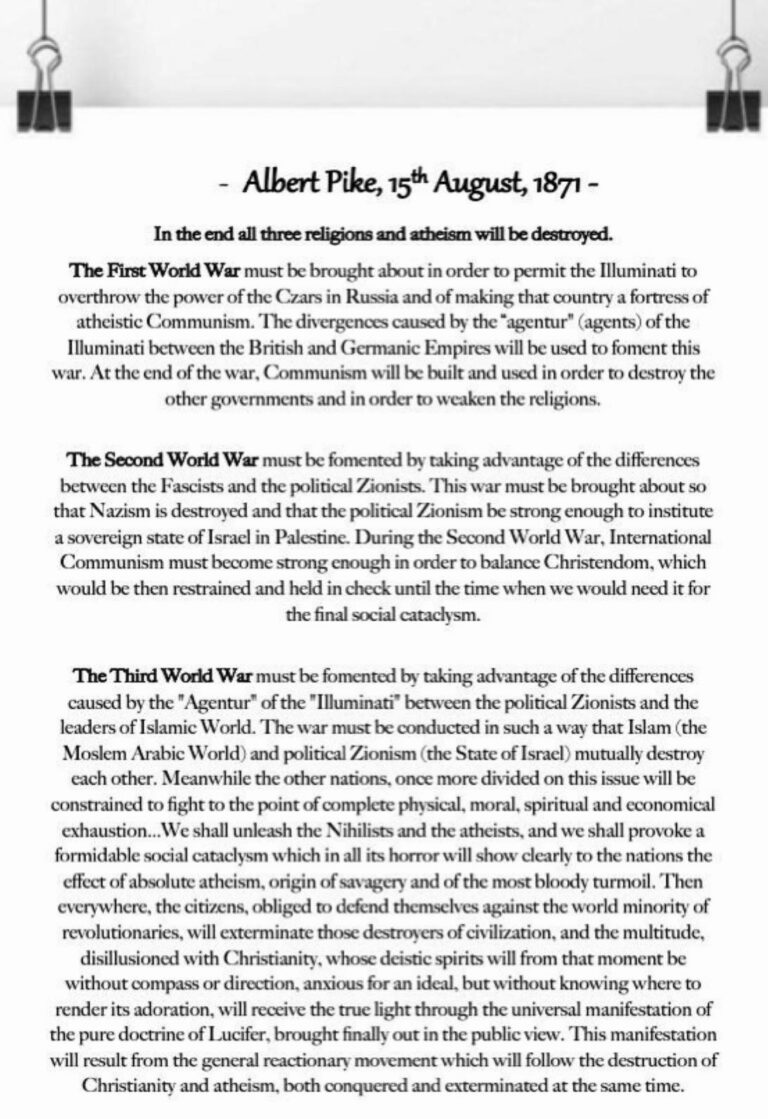
This letter was sent to Giuseppe Mazzini, a prominent 19th-century Italian nationalist, outlines a prophetic vision of global conflicts. Mazzini, who founded “Young Italy” to promote republican ideals and inspire revolutions across Europe, is said to have predicted that the first world war would lead to the downfall of the Tsarist regime and the rise of atheistic communism. The second conflict would see fascism clash with Zionism, ultimately resulting in the defeat of Nazism and the establishment of Israel in 1948. The third war is portrayed as a struggle between political Zionists and Islamic leaders, culminating in mutual destruction and widespread chaos. Current global tensions, particularly in regions like Gaza, Lebanon, and Iran, alongside the collapse of Syria and the Russia-NATO conflict in Ukraine, suggest that we may be following a script laid out in this letter. The invocation of terms such as “Zionism” and “fascism,” which were not in circulation in 1871, further reinforces the notion that today’s conflicts may be part of a long-foreseen plan.
Reding between the lines of Albert Pike’s prediction regarding world wars reveals that World War I was a strategic move to establish financial dominance, significantly influenced by China’s opium trade. This event, akin to the Holocaust, has fostered a deep-seated “century of humiliation” narrative among Chinese citizens. Though not being propagated in the West, it is ingrained in education to evoke a victim complex against the West.
World War II, in contrast, was orchestrated as a military manoeuvre, utilising the United States as springboard, which enabled Israel to develop formidable military capabilities through taxpayer funding and technological expertise from Silicon Valley, leading to today’s complex interrelations.
The threat of a third world war is closely tied to a scheme aimed at achieving total digital control through artificial intelligence, a plan that has been developing for a century. While nations and individuals remain preoccupied with survival, they remain oblivious to the deeper motives at play. Historically, the masses have been ensnared by ethical facades that yield unethical outcomes—much like my initial perception of John Howard’s GST proposal, which I believed to be a fairer tax system and voted for it, only to realise much later, it served as another means of revenue collection for the oligarchs who control the economy. In light of historical precedents, such as the introduction of income and payroll tax by the United States Federal Reserve in 1913, which was intended to target the wealthy but ultimately placed a burden on average citizens, we must impose caveats on any changes to laws that could potentially harm our society and scrutinise the fine print in proposed legislation. The role of elected officials is to safeguard the interests of their constituents. A person who cannot demonstrate loyalty to their country cannot be trusted to be loyal to anyone else.
During WWI, gold transfer shifted power from Britain to the U.S. It raises concerns about the implications of gold disappearing from the U.S. Treasury following Trump’s second term, suggesting this could indicate a shift of power from the U.S., possibly after a planned World War III. But to which country? The question remains: which country might benefit from this shift?
It may be time to stop fighting amongst ourselves and instead focus on these malevolent forces pulling the strings in the shadows.
Controlled Oppositions
The Unspoken Atrocities of the Allied Forces in World War II highlight that while the Axis powers are often blamed for their actions, the Allies also caused significant suffering and loss of life. A notable example is the Katyn Forest massacre, where around 22,000 Polish military officers and policemen were executed by the Soviet NKVD. Initially, the Soviet Union falsely accused Germany of this crime, hiding their involvement for nearly fifty years. Additionally, Allied bombing campaigns led to massive civilian casualties, with firebombing in cities like Tokyo, Dresden, and Hamburg resulting in tens of thousands of deaths. In Tokyo alone, a single night of bombing in March 1945 killed an estimated 80,000 to 100,000 people. The atomic bombings of Hiroshima and Nagasaki also caused unprecedented destruction and loss of civilian life. After the war, the Soviet Union emerged as a superpower, partly due to U.S. support, which some argue contributed to the Cold War and later conflicts like the Korean and Vietnam Wars. There are differing views on whether U.S. involvement helped prevent a Soviet victory over Germany or if it simply set the stage for future tensions. The spread of communism in places like China, Korea and Southeast Asia was evidently influenced by Zionist Jews.
The Rothschilds is often accused of funding both sides in various conflicts, orchestrating World War II, and profiting from war casualties. Historically, the British branch of the Rothschilds collaborated with the British government on war financing, currency stabilisation, and international loans. Lord Victor Rothschild, who worked for MI5, was involved in British counterintelligence and later faced accusations of being a Soviet spy.
The Rothschilds have also been strong supporters of Zionism, financing Jewish settlements in British Mandate Palestine and contributing to resettlement efforts for Jews, particularly in the US, UK, New Zealand, Australia, and Switzerland.
Today, the Rothschilds and its network are extremely wealthy, multi-generational financiers involved in private banking and wealth management. Rothschild & Co specialises in mergers and acquisitions, wealth management, and private equity, serving governments, corporations, and ultra-high-net-worth individuals. However, beneath their opulent facade lies a ruthless pursuit of wealth, with countless lives sacrificed in their relentless quest for power, all while they manipulate others to obscure their nefarious actions.
Their wealth is distributed across generations, companies, and trusts, often under the alias, making it difficult to determine a consolidated net worth. They have privatised most of their financial businesses but maintain control through intermediaries like BlackRock, Vanguard, and State Street, which serve as conduits for their money laundering activities. The manipulation of government legislation has been a deliberate strategy, facilitating the creation of advanced money laundering operations. These operations utilise humanitarian aid, shell companies, tax-exempt nonprofits, and government grants, ultimately serving illicit interests rather than the rightful beneficiaries. Atlas Network is seen as a conduit for billionaire money laundering mechanism, running a spy network to influence government legislations while benefiting from tax-exempt status.
Are Rothschilds network the architects of global power, or are they simply wealthy scapegoats caught in the crossfire of history? You decide.
Just remember the history you were taught was written through the lens of the Victor deciding what gets condemned, ignored or quietly justified.
Lest We Forget
I have turned my illness into a powerful catalyst for exposing the harmful elements in our society, especially within the seven mountain spheres referenced in Evangelical belief. Throughout my recovery, I dedicated time to research and introspection, documenting my experiences in journals. This journey not only facilitated my healing but also aimed to reveal the concealed forces that exploit our communities. It highlights the challenges we face and encourages others to tackle these issues head-on, as time is of the essence.
India’s transformation into a colony predates that of China, serving as the source of opium supply that helped with China’s subjugation. The establishment of Israel appears less about Jewish people and more on reshaping the Middle East into colonies for “the Firm,” with Israel acting as a strategic command centre, akin to Japan’s role in destabilising China. The firm strategically targeted the Jewish religion, as well as India and China, recognising their substantial population densities.
This strategy aimed to implement a mixed-race agenda, intending to undermine and dilute the cultural identities of other nations. However, it inadvertently contributed to uniting humanity in an ever-evolving world. This dynamic has resulted in the persecution of Indian, Jewish, and Chinese citizens by their own oligarchs, who have thrived with the assistance of the Firm in sustaining colonial control.
The Eight-Nation Alliance八國聯軍 during China’s Opium wars—comprising Germany, Japan, Russia, Britain, France, the United States, Italy, and Austria-Hungary—suggests these nations were already captured by the Firm prior to the colonisation of China.
The Firm’s reliance on these oligarchs to maintain their colonies explains the immense wealth of the oligarchs, which can be easily taken away by any small misstep which means that their immense wealth also serves as their greatest prison, a real life “Truman Show.” The extravagant wedding of Anant Ambani and Radhika Merchant unfolds a modern-day Truman Show, where every meticulously curated moment serves as global theatre, masking the calculated consolidation of power and capital that defines the ultimate Rothschild model of dynastic dominance.
As we reflect on our history, we can draw inspiration from figures like Abraham Clark, a signer of the Declaration of Independence. He faced a harrowing choice when the British offered to free his sons in exchange for denouncing the Declaration. Clark chose integrity over ease, understanding that such decisions shape the future of generations. President Chiang Kai-shek continued to fight for China’s sovereignty while his son was held hostage by Stalin. Patriotism is not merely a sentiment; it requires action, gratitude for our freedoms, and a commitment to protect our nation, recognise that the struggle of the people and the world, requires each of us to step up and fight for our shared values.
19th July 2026